FTA-Registered & Regulated Tax Agent
Ensure your company stays fully compliant with e-invoicing uae standards, avoids penalties, and simplifies VAT processes with our expert e invoicing consulting guidance.
Start E-Invoicing Today — Contact Us
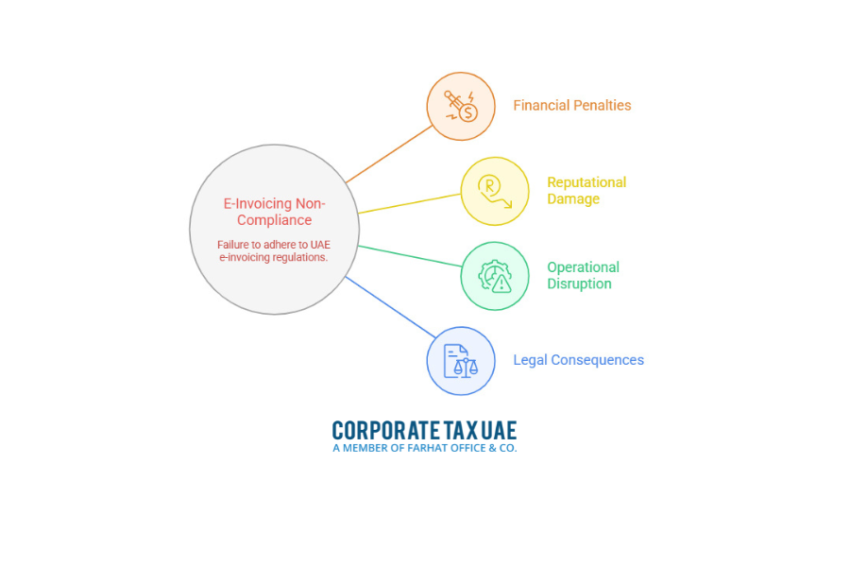
Phase 1 deadline — 30 October 2026 : Businesses with annual revenue ≥ AED 50M must appoint an ASP. Mandatory go-live is 1 January 2027. Non-compliance attracts AED 5,000/month in penalties under Cabinet Decision No. 106 of 2025.
Book Consultation
Meet Our E-invoicing Specialists

Ahmad Ali Jourieh
Senior Tax Agent

Anas Al Salman
CT/VAT Senior Tax consultant

Mohamed Zahran
Audit Manager

Mohammed Fashan
Accountant
UAE E-Invoice Implementation Timeline
Know Your Deadline — And Start Before It
The UAE’s phased e-invoicing mandate has hard deadlines with no grace periods. Here is where your business falls and what you need to do — and by when.
| Phase | Applicable Entities | ASP Appointment Deadline | Mandatory Go-Live | Status |
|---|---|---|---|---|
| Phase 1 | Annual revenue ≥ AED 50 million | 30 Oct 2026 | 1 Jan 2027 | Act now |
| Phase 2 | Annual revenue < AED 50 million | 31 Mar 2027 | 1 Jul 2027 | Plan now |
| Phase 3 | Government entities | 31 Mar 2027 | 1 Oct 2027 | Assess now |
* Voluntary adoption opens 1 July 2026 and carries a full exemption from penalties under Cabinet Decision No. 106 of 2025 until your mandatory date arrives. B2C transactions are excluded until a further ministerial decision, along with limited exclusions for certain financial services and airline transactions.

What Is E-Invoicing?
E-invoicing is the process of sending and receiving invoices in a structured and computer-readable format that allows for automated validation and secure transmission between trading partners. It should be noted that structured e-invoicing is not the same as the following:
- PDF invoices
- Scanned invoices
- Handwritten invoices sent via email
These are electronic invoices but do not meet the structured data requirements required in the UAE e-invoicing program. Structured e-invoices must:
- Be sent in a prescribed structured format.
- Contain mandatory data fields.
- Be transmitted through accredited service providers approved by the Ministry of Finance.
- Be VAT-compliant for record-keeping purposes.
Get UAE E-Invoicing Ready
Ensuring Mandatory Fields in Your E-Invoices
The fields below are mandatory in the invoices, as per the UAE e-invoice requirements framework:
These fields must be presented in the structured format prescribed by the authority so the invoice can be validated automatically.
UAE E-Invoicing Framework Overview
| Topic | Details |
|---|---|
| Legal Framework and Government Initiative | The UAE e-invoicing system is part of the Ministry of Finance’s digital tax transformation strategy. It aligns with international best practices and strengthens tax transparency and compliance. The system is established by Ministerial Decision No. 243 of 2025 on the Electronic Invoicing System and Ministerial Decision No. 244 of 2025 on its implementation, both issued on 29 September 2025. Penalties are set by Cabinet Decision No. 106 of 2025. These sit on top of Federal Decree-Law No. 8 of 2017 (VAT Law) and Federal Decree-Law No. 28 of 2022 (Tax Procedures Law), which already require valid tax invoices. |
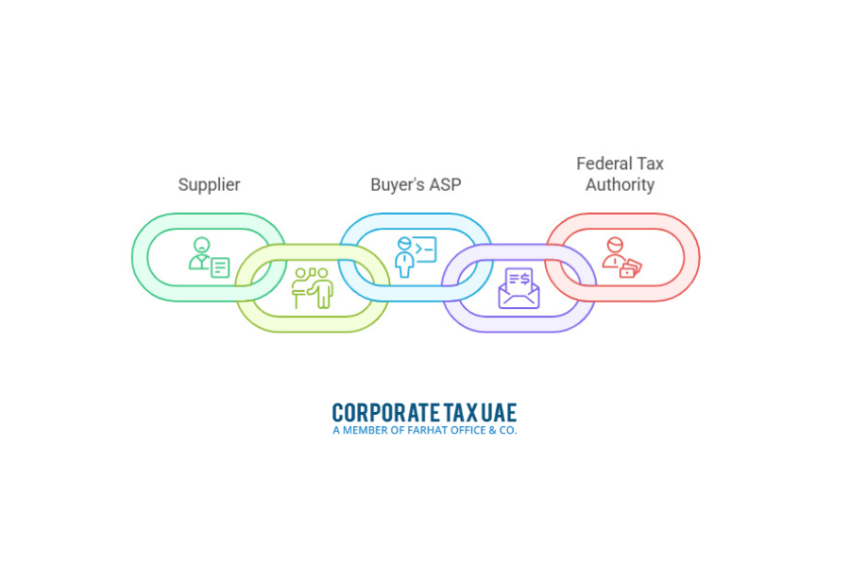
| The Peppol-Based 5-Corner Model | The UAE has adopted the Peppol-Based 5-Corner Model, which is also referred to as the Decentralised Continuous Transaction Control and Exchange (DCTCE) model. In simpler terms, the Supplier and Buyer can exchange invoices through the following parties:
|
Our specialized e invoicing consulting team provides strategic advice and implementation support to align your business with the UAE E-Invoicing Framework Overview, ensuring complete compliance with the official Legal Framework and Government Initiative.
Key Dates & Phases of E-Invoicing in UAE
The UAE’s e-invoicing process is rolled out in phases depending on revenue and business type. The phase dates are set out in the timeline table above. Three points sit behind those dates:
- The ASP appointment deadline is not the go-live date. Appointing a provider starts the project rather than finishing it.
- Voluntary adoption opens 1 July 2026 and removes all penalty exposure under Cabinet Decision No. 106 of 2025 until your mandatory date arrives.
- Scope is set by Ministerial Decision No. 243 of 2025 and the phase dates by Ministerial Decision No. 244 of 2025.
Future Expected Expansion
B2C transactions remain outside the system until a further ministerial decision extends it. The dates and categories may change through MoF and FTA announcements.

Key Role of Ministry of Finance & FTA in UAE E-Invoicing
The Ministry of Finance:
- Establishes the regulatory framework
- Approves the accredited e-invoicing service providers
- Publishes the implementation guidelines
The Federal Tax Authority:
- Ensures VAT compliance in the UAE
- Verifies the integrity of the invoice data
- Ensures tax law compliance
The accredited e-invoicing providers in the UAE are published through MoF announcements. Only accredited providers can support the exchange of invoices when the obligation is enforced.
Archiving and Record Retention
The record-keeping obligation under VAT law also applies in the digital age.
The following apply:
- Invoices must be retained for the statutory period set out in the Tax Procedures Law
- Invoice data must be stored inside the UAE and not on overseas servers
- Accessibility for FTA audit purposes must be maintained
- System failures that prevent e-invoicing must be reported to the FTA within 2 business days, by both the issuer and the recipient
E-invoicing does not waive the archiving requirement; it enhances traceability.
Set Up FTA-Compliant E-Invoicing
Who is Eligible for UAE E-Invoicing Compliance?
Importance of Approved E-Invoicing Service Providers
Accredited Providers Only
Only approved e-invoicing providers in the UAE, those accredited by the Ministry of Finance and recognized by the FTA can process the structured invoice exchange under the approved framework. Invoices sent through unapproved channels may be considered non-compliant once the mandatory phases are in effect.
Using accredited providers ensures that:
- Invoices are sent securely and correctly
- System validation is in line with regulatory requirements
- Records are maintained in accordance with archiving regulations
Using unapproved systems or tools may put the business at risk of non-compliance.
How E-Invoicing is Connected to Corporate Tax and VAT Compliance
E-invoicing is not an isolated process. It directly affects other areas of compliance, including:
- VAT output filings
- Verification of claims for input VAT recovery
- Readiness for audits
- Consistency of corporate tax UAE documentation
Dates, amounts, and calculations of tax on invoices should be consistent with VAT filings and accounting statements. Inconsistencies may impact accuracy.
How We Support Your Compliance Readiness
We do not operate as an accredited e-invoicing service provider, nor do we process or exchange invoices.
Our service is purely advisory.
We support businesses with:
- Business Readiness Assessments: Confirming which implementation phase applies to your business and what it requires of you.
- Compliance Gap Analysis: Analyzing gaps between your existing invoicing practices and the standardized e-invoicing format.
- Corporate Tax UAE Alignment: Checking that invoice data holds up against your VAT filings and corporate tax records.
- ERP Workflow Guidance: Guiding clients on the impact of standardized invoicing on accounting and finance workflows.
- Referral to Approved Providers: Referencing clients to accredited e-invoicing service providers officially approved by the Ministry of Finance.
- Ongoing Regulatory Update Support: Supporting clients with updates under existing legislation and official announcements.
Talk to an E-Invoicing Specialist