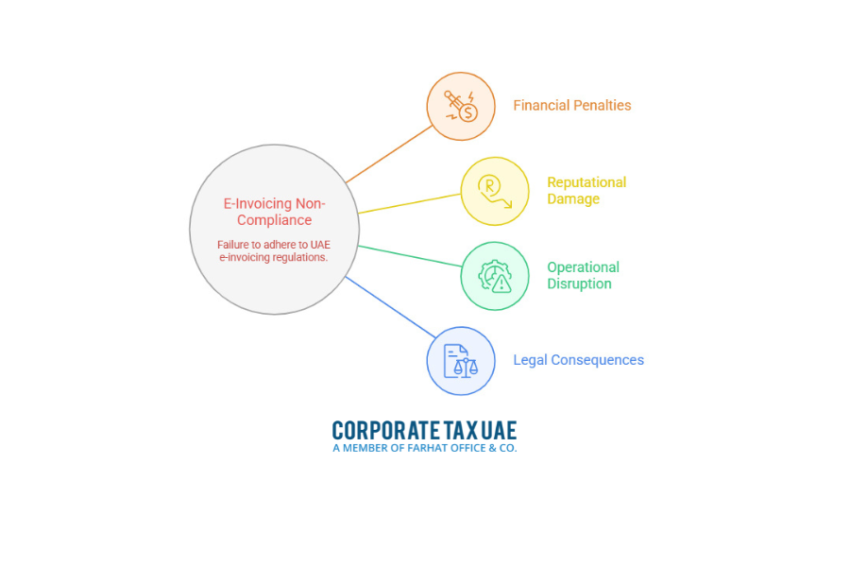
Introduction E-Invoicing Penalties and Fines:
When the UAE Ministry of Finance published Cabinet Decision No. 106 of 2025 on 24 November 2025, it completed the legal architecture of the UAE’s e-invoicing mandate. The framework documents — Ministerial Decision No. 243 of 2025 establishing the Electronic Invoicing System and Ministerial Decision No. 244 of 2025 setting implementation timelines — were already in place. Cabinet Decision No. 106 added the enforcement layer: a structured table of violations and the specific administrative penalty attached to each one.
This is not aspirational guidance. The penalties are grounded in Federal Decree-Law No. 28 of 2022 on Tax Procedures and cross-reference Cabinet Decision No. 40 of 2017 on administrative penalties for tax law violations. They apply from the date each business becomes mandatory under the phased rollout, and they compound — every month of a delayed setup, every non-compliant invoice, every unreported outage accumulates its own separate penalty. This article sets out exactly what the law says, what each violation costs, and where businesses are most likely to fall into penalty territory.
The Legal Framework Behind the Penalties
Cabinet Decision No. 106 of 2025 draws its authority from several pieces of legislation that together form the complete UAE e-invoicing compliance structure:
- Federal Decree-Law No. 8 of 2017 on Value Added Tax (and its amendments), which establishes the VAT invoicing obligations that e-invoicing now formalizes into structured digital format
- Federal Decree-Law No. 28 of 2022 on Tax Procedures, which governs the administrative relationship between businesses and the Federal Tax Authority (FTA) and provides the enforcement basis for the penalties
- Federal Decree-Law No. 13 of 2016 on the Establishment of the Federal Tax Authority, which gives the FTA the authority to impose and collect administrative penalties
- Cabinet Decision No. 40 of 2017 on Administrative Penalties for Violation of Tax Laws, which the e-invoicing penalties sit alongside and cross-reference
The Decision defines three key terms that determine who these penalties apply to:
Issuer — any person who is obligated to issue, transmit, share, and exchange electronic invoices and electronic credit notes through the Electronic Invoicing System.
Recipient — any person who is required to receive electronic invoices and electronic credit notes through the Electronic Invoicing System.
System Failure — any technical malfunction, disruption, or unavailability of the Electronic Invoicing System that prevents the issuer or recipient from meeting their obligations under the legislation.
Article 2 of the Decision clarifies one important boundary: the penalty regime does not apply to businesses that voluntarily adopt e-invoicing before they fall within the mandatory scope. A business that chooses to go live early is not penalised for any procedural gaps during its voluntary period. Penalties begin only from the date that business becomes formally mandated.
The Phased Rollout and When Penalties Begin
The penalty regime cannot be understood without the implementation timeline established under Ministerial Decision No. 244 of 2025. Penalties do not apply uniformly from a single date — they apply to each business from the date it enters the mandatory scope.
| Phase | Businesses Covered | Pilot / Voluntary Start | Mandatory Enforcement |
| Phase 1 | Annual turnover above AED 50 million | 1 July 2026 | 1 January 2027 |
| Phase 2 | All remaining VAT-registered businesses | 1 July 2027 | 1 July 2027 |
| B2G | All business-to-government transactions | 1 October 2027 | 1 October 2027 |
A Phase 1 business that has not implemented the Electronic Invoicing System or appointed an accredited service provider by 1 January 2027 begins accumulating the monthly implementation penalty from that date. A Phase 2 business reaches the same position from 1 July 2027.
The Six Violations and Their Penalties
The annexed table to Cabinet Decision No. 106 of 2025 sets out six specific violations and the administrative penalty attached to each. What follows is each violation exactly as drafted in the official English text of the Decision, with an explanation of how it applies in practice.
Violation 1: Failure to implement the Electronic Invoicing System, including failure to appoint an Accredited Service Provider within the prescribed timeline
Penalty: AED 5,000 for each month of delay, or part thereof
This is the foundational penalty and the one with the broadest scope. It captures two distinct failures: not implementing the Electronic Invoicing System at all, and implementing it but failing to appoint an accredited service provider (ASP) to act as the access point.
The phrase “or part thereof” is important. If a business is non-compliant for six weeks, it is penalised for two calendar months — not for one month and a fraction. Every partial month counts as a full month for penalty calculation purposes.
In practice, this penalty applies to any business that reaches its mandatory date without a live, accredited ASP connection through which invoices are being transmitted. Having signed a contract with a pre-approved provider is not sufficient — the provider must hold full accreditation under Article 16 of Ministerial Decision No. 64 of 2025, and the system must be operational.
A business that delays implementation by three months accumulates AED 15,000 in penalties before it has issued a single invoice. A business that delays for a full year faces AED 60,000 from this violation alone.
Violation 2: Failure to issue and transmit an Electronic Invoice to the recipient within the prescribed timeline
Penalty: AED 100 per electronic invoice, capped at AED 5,000 per calendar month
Once a business is within the mandatory scope, every invoice it issues must be transmitted through the Electronic Invoicing System within the timeline specified by the Minister. An invoice issued outside the system — whether as a PDF, a paper document, or a system-generated file that is not transmitted through the accredited ASP — triggers this penalty.
The AED 100 per-invoice penalty accumulates until it reaches AED 5,000 in a given calendar month, at which point the monthly cap applies and no further per-invoice penalties are added for that month. This means the cap is reached after 50 non-compliant invoices in a month.
For businesses with high invoice volumes, the cap is actually the relevant figure: any business issuing more than 50 invoices per month that falls out of system compliance will pay AED 5,000 per month from this violation alone, in addition to any other penalties that apply concurrently.
The cap resets each calendar month. A business that is non-compliant across six months faces up to AED 30,000 from this violation category.
Violation 3: Failure to issue and transmit an Electronic Credit Note to the recipient within the prescribed timeline
Penalty: AED 100 per electronic credit note, capped at AED 5,000 per calendar month
The structure of this penalty is identical to Violation 2, applied specifically to credit notes. Credit notes — issued when an invoice is cancelled, returned, or adjusted — are treated as separately regulated documents under the Electronic Invoicing System. A credit note that is not transmitted through the accredited ASP within the required timeframe carries its own AED 100 penalty, with its own monthly cap of AED 5,000.
The caps for Violations 2 and 3 are separate. A business with a large number of both non-compliant invoices and non-compliant credit notes in the same month can accumulate up to AED 10,000 from these two categories combined.
Violation 4: Failure by the Issuer to notify the Authority of a System Failure within the prescribed timeline
Penalty: AED 1,000 per day of delay, or part thereof
This is one of the more operationally demanding obligations in the framework. When a system failure occurs — defined as any technical malfunction, disruption, or unavailability of the Electronic Invoicing System that prevents the issuer from meeting its obligations — the issuer must notify the Federal Tax Authority within the timeline specified by the Ministry. Failure to do so triggers a daily penalty.
The notification obligation exists precisely because a system failure creates a period during which invoices cannot be transmitted through the Electronic Invoicing System. The notification to the FTA provides legal cover for that gap — without it, the issuer remains exposed to the per-invoice penalties under Violation 2 for every invoice that could not be transmitted during the outage.
An issuer that experiences a three-day outage and fails to notify the FTA for five days accumulates AED 5,000 in Violation 4 penalties before the notification issue is even resolved, and may simultaneously be accumulating Violation 2 penalties for invoices issued during the outage period.
This penalty makes it essential that businesses have a clearly defined internal process for identifying system failures, determining the notification timeline, and escalating to the FTA immediately. It cannot be left to manual discovery.
Violation 5: Failure by the Recipient to notify the Authority of a System Failure within the prescribed timeline
Penalty: AED 1,000 per day of delay, or part thereof
Cabinet Decision No. 106 extends the system failure notification obligation to recipients, not just issuers. If a recipient’s access to the Electronic Invoicing System fails — preventing them from receiving compliant electronic invoices — they are also required to notify the FTA within the prescribed timeline. Failure to do so carries the same daily penalty as Violation 4.
This is a compliance obligation that many businesses have not yet built into their accounts payable processes. The obligation falls on any entity that is a mandated recipient of electronic invoices, and the penalty accumulates daily in the same way as for issuers.
Violation 6: Failure by the Issuer or Recipient to notify the Accredited Service Provider of changes to registered data within the prescribed timeline
Penalty: AED 1,000 per day of delay, or part thereof
This violation covers master data maintenance. When a business registers with its accredited service provider, it provides data that is also registered with the FTA — legal entity name, TRN, address, and other identifying information. If any of that registered data changes — through a company restructure, address change, TRN update, or similar event — the business is required to notify its ASP of the change within the timeline specified by the Ministry.
The penalty runs at AED 1,000 per day from the point the notification was due, not from the point the change occurred. A business that updates its registered address but fails to notify its ASP for thirty days accumulates AED 30,000 in penalties from this violation alone.
This obligation connects the e-invoicing framework to a business’s broader master data governance. Any change to the legal entity or tax registration details held by the FTA must also flow through to the ASP within the required timeframe.
Summary: All Six Penalties in One Table
| # | Violation | Who It Applies To | Penalty |
| 1 | Failure to implement the system or appoint an ASP by the deadline | Issuer | AED 5,000 per month (or part thereof) |
| 2 | Failure to issue and transmit an electronic invoice within the required timeframe | Issuer | AED 100 per invoice, max AED 5,000 per calendar month |
| 3 | Failure to issue and transmit an electronic credit note within the required timeframe | Issuer | AED 100 per credit note, max AED 5,000 per calendar month |
| 4 | Failure to notify the FTA of a system failure within the required timeframe | Issuer | AED 1,000 per day (or part thereof) |
| 5 | Failure to notify the FTA of a system failure within the required timeframe | Recipient | AED 1,000 per day (or part thereof) |
| 6 | Failure to notify the ASP of changes to FTA-registered data within the required timeframe | Issuer or Recipient | AED 1,000 per day (or part thereof) |
How Penalties Compound in Practice
The six violations are independent of each other. A single compliance failure can simultaneously trigger multiple penalties, and each runs its own accumulation clock.
Consider a business that reaches its mandatory date without a functioning ASP connection, continues operating for three months before going live, and during that period experiences a system issue that it fails to report promptly.
Violation 1 runs at AED 5,000 per month for three months: AED 15,000.
Violation 2 runs at up to AED 5,000 per month for three months for all the invoices issued outside the system: up to AED 15,000.
Violation 3 runs separately for any credit notes issued outside the system during the same period: up to AED 15,000.
Violation 4 runs at AED 1,000 per day for each day the system failure goes unreported.
These figures are additive. A business in this position can accumulate well over AED 50,000 in penalties from a three-month delay — before any other FTA enforcement action is considered.
The Violations the Decision Does Not Explicitly Cover
Cabinet Decision No. 106 focuses on structural and procedural non-compliance — late setup, non-transmission, and failure to report. It does not set out a specific penalty for falsified invoice data or deliberately incorrect information in transmitted invoices. However, that does not mean falsified data is without consequence.
Submitting false or manipulated data through the Electronic Invoicing System engages the existing penalty provisions under Federal Decree-Law No. 28 of 2022 on Tax Procedures and the broader FTA enforcement framework, which includes penalties for tax evasion and submission of incorrect returns. The e-invoicing system creates a direct data feed to the FTA — any manipulation of that data is immediately within the FTA’s visibility and subject to its full investigative and enforcement powers.
Protect Your Business: E-Invoicing Compliance Advisory from Corporate Tax UAE
Corporate Tax UAE helps UAE businesses assess their exposure to e-invoicing penalties before they become mandatory. Our advisory work covers the full range of compliance risks set out in Cabinet Decision No. 106 of 2025 — from confirming your ASP appointment and implementation timeline against your mandatory date, to reviewing your internal processes for system failure notification, and auditing your master data governance to ensure changes are reported to your ASP within the required timeframe.
We also work with businesses on the practical compliance infrastructure that the penalty regime demands: documented escalation procedures for outages, internal ownership for FTA notifications, and data change workflows that ensure Violation 6 exposure is eliminated. If your business is in Phase 1 — annual turnover above AED 50 million — the penalty clock starts on 1 January 2027. Contact Corporate Tax UAE for E-Invoicing Advisory services now to confirm your readiness position and close any gaps before that date.
Conclusion
Cabinet Decision No. 106 of 2025 makes the cost of non-compliance with UAE e-invoicing specific, quantifiable, and cumulative. There is no ambiguity in the penalty table: late setup costs AED 5,000 per month, non-compliant invoices cost AED 100 each up to AED 5,000 per month, and unreported outages or data changes cost AED 1,000 per day. These penalties apply independently and accumulate simultaneously across multiple violation categories.
The businesses most at risk are not the ones that have decided to ignore the mandate — they are the ones that have started too late, chosen a provider that fails to achieve accreditation in time, or built no internal process for the notification obligations that the Decision imposes on both issuers and recipients. The penalty framework treats all of these failures the same way: systematically and without grace periods beyond the mandatory date.