


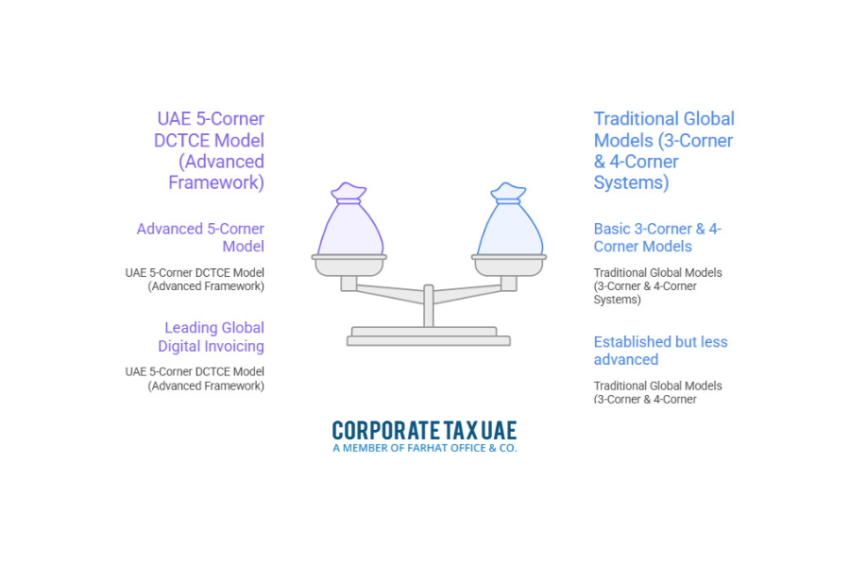
The UAE is positioning itself as a global leader in digital taxation by implementing the Decentralized Continuous Transaction Control and Exchange (DCTCE) model, commonly known as the 5-Corner e-invoicing system. Unlike older global models that rely on delayed reporting or limited validation, the UAE system enables real-time invoice validation, transmission, and tax reporting through a fully integrated network.
This makes the UAE one of the most advanced digital tax ecosystems in the world.
Traditional Global Models (3-Corner & 4-Corner Systems)
3-Corner Model (Basic Reporting System)
The 3-corner model is the simplest form of e-invoicing used in early digital tax systems.
It includes:
- Supplier (invoice issuer)
- Buyer (invoice receiver)
- Tax authority (receives periodic reports)
Key limitation:
- Tax authorities receive data after the transaction
- No real-time validation
- Higher risk of tax gaps and reporting errors
- Heavy reliance on manual audits
This model is mostly used in older or low-digital maturity systems.
4-Corner Model (Peppol Standard)
The 4-corner model is widely used in countries adopting the Peppol network.
It includes:
- Supplier ERP system
- Supplier Access Point
- Buyer Access Point
- Buyer ERP system
Key improvement:
- Standardized invoice exchange via Access Points
- Structured XML format (UBL-based)
- Better interoperability between systems
Key limitation:
- Tax authority is still outside the live transaction flow
- Reporting is often delayed or separate
- Limited real-time tax visibility
UAE 5-Corner DCTCE Model (Advanced Framework)
The UAE enhances the 4-corner Peppol model by adding a fifth critical node: the Federal Tax Authority (FTA).
The 5 Corners:
- Supplier (ERP system)
- Supplier Access Point (ASP)
- Buyer Access Point (ASP)
- Buyer ERP system
- Federal Tax Authority (FTA)
Key upgrade:
The FTA is now part of the real-time transaction flow, not an external observer.
Key Differences: UAE vs Global Models
Real-Time Tax Reporting
- UAE: Transactions reported instantly to FTA
- 4-Corner: Reporting is delayed or periodic
- 3-Corner: Fully retrospective reporting
UAE provides continuous tax visibility instead of post-filing audits.
Level of Automation
- UAE: Fully automated validation + reporting + routing
- 4-Corner: Automated exchange but limited tax integration
- 3-Corner: Mostly manual compliance checks
UAE removes manual tax dependency almost completely.
Fraud Prevention Capability
- UAE: Real-time validation prevents fake or duplicate invoices instantly
- 4-Corner: Fraud detected after reporting cycle
- 3-Corner: Fraud often detected during audits only
UAE significantly reduces VAT fraud risk.
Data Consistency & Standardization
- UAE: Strict PINT-AE XML enforcement across all sectors
- 4-Corner: Standard format, but less tax-specific enforcement
- 3-Corner: Highly inconsistent formats
UAE ensures uniform invoice structure nationwide.
Government Visibility
- UAE: Full live visibility of B2B & B2G transactions
- 4-Corner: Limited visibility until reporting
- 3-Corner: No live monitoring
UAE enables real-time economic intelligence.
Why UAE Model is Considered Global Best Practice
The UAE DCTCE model is considered advanced because it combines:
- Peppol interoperability (global standard)
- Real-time tax control (government integration)
- Centralised risk analytics (FTA monitoring)
- Decentralised infrastructure (no single bottleneck)
- Scalable ERP integration for all business sizes
This hybrid approach balances speed, control, and compliance better than traditional systems.
Strategic Impact on Businesses
The UAE model changes how businesses operate:
- Invoice validation happens before tax reporting
- Errors are caught instantly, not during audits
- Payment cycles become faster due to structured data
- ERP systems must become fully digital and XML-ready
- Compliance becomes continuous, not periodic
How can We help with implementation?
Corporate Tax UAE helps businesses implement the UAE e-invoicing framework by providing ERP integration support, XML/PINT-AE mapping, ASP onboarding assistance, and full compliance configuration. We ensure businesses are aligned with the 5-corner model requirements, reduce system rejection risks, and prepare organizations for mandatory rollout deadlines with a smooth, fully compliant digital transition.
Final Insight
The UAE’s 5-Corner DCTCE model represents a shift from reactive tax systems to real-time digital tax governance. By integrating the tax authority directly into the transaction flow, the UAE has created one of the most advanced, transparent, and automated invoicing ecosystems globally.
This positions the UAE as a leader in next-generation digital taxation frameworks.
FAQs About Global Digital Invoicing Framework
What makes the UAE e-invoicing model different from global systems?
Why is the 5-corner model more secure than 4-corner systems?
Does the UAE system replace traditional invoicing completely?
How does the UAE model improve tax compliance?

Corporate Tax UAE
United Arab Emirates
Tel: +971 4 2500251 | Email:[email protected]