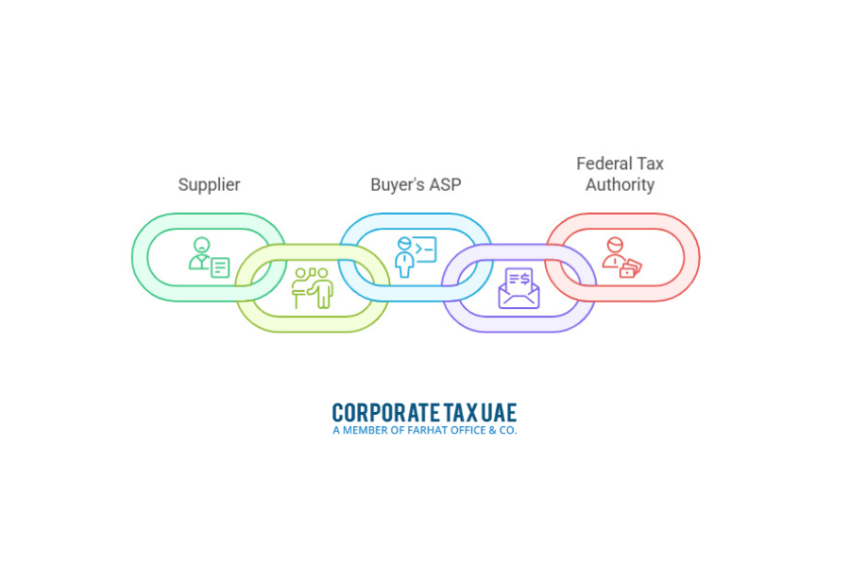
The UAE is implementing a modern electronic invoicing framework called the Decentralized Continuous Transaction Control and Exchange (DCTCE) model, commonly known as the 5-Corner Model. This system is based on the international Peppol network and will become the foundation of the UAE’s national e-invoicing infrastructure.
Instead of businesses simply emailing PDF invoices to customers, invoices will now move through a structured digital network where invoice data is validated, exchanged, and reported electronically.
The objective of the UAE 5-Corner Model is to improve transparency, reduce tax fraud, automate invoice exchange, and modernize the country’s tax ecosystem.
Businesses can review official UAE guidance through the UAE Ministry of Finance (MoF) and the Federal Tax Authority (FTA).
What is the UAE 5-Corner E-Invoicing Model?
The UAE 5-Corner Model is a structured invoice exchange system where invoices move through multiple secure digital points instead of being directly emailed between businesses.
The system connects:
- The Supplier
- The Supplier’s Accredited Service Provider (ASP)
- The Buyer’s Accredited Service Provider (ASP)
- The Buyer
- The Federal Tax Authority (FTA)
This creates a secure and traceable invoice exchange environment where invoice data can be validated automatically and reported digitally.
Simple Example of How the System Works
Imagine a supplier selling products to another business.
Under the old system:
- The supplier creates a PDF invoice
- The invoice is emailed manually
- The buyer enters invoice data manually
- Tax authorities review records later during audits
Under the UAE 5-Corner Model:
- The supplier creates the invoice digitally
- The invoice moves through certified ASP platforms
- The invoice is validated automatically
- The buyer receives the invoice electronically
- The FTA receives transaction reporting information in real time
This makes invoicing faster, more accurate, and more transparent.
Understanding Each Corner of the UAE DCTCE Model
Corner 1 – The Supplier
Corner 1 is the business issuing the invoice.
The supplier creates the invoice using its ERP, billing software, or accounting system such as:
- SAP
- Oracle
- Microsoft Dynamics
- Zoho
- Odoo
- QuickBooks
Instead of sending a PDF manually, the invoice data is transmitted electronically to the supplier’s Accredited Service Provider (ASP).
Corner 2 – Supplier’s Accredited Service Provider (ASP)
Corner 2 is the supplier’s ASP.
The ASP acts like a secure digital gateway between the supplier and the UAE e-invoicing network.
The ASP performs several important functions:
- Converts invoice data into the UAE PINT AE XML format
- Validates invoice structure
- Checks required tax fields
- Verifies invoice formatting
- Sends invoice data securely through the network
- Reports transaction data to the FTA
The ASP is one of the most important parts of the UAE e-invoicing system.
Official UAE updates regarding ASPs are available through the UAE Ministry of Finance E-Invoicing Initiative.
Corner 3 – Buyer’s Accredited Service Provider (ASP)
Corner 3 is the buyer’s ASP.
This ASP receives the invoice from the supplier’s ASP through the Peppol network.
The buyer’s ASP:
- Validates the incoming invoice
- Verifies identity information
- Checks invoice compliance
- Transfers the invoice into the buyer’s accounting system
This automated validation process helps reduce invoice errors and failed invoice processing.
Corner 4 – The Buyer
Corner 4 is the customer or receiving business.
Once the invoice passes validation, it automatically enters the buyer’s ERP or accounts payable system.
This helps businesses:
- Reduce manual data entry
- Speed up invoice approvals
- Improve payment workflows
- Reduce processing errors
- Improve invoice tracking
The buyer can then process the invoice internally using automated approval systems.
Corner 5 – The Federal Tax Authority (FTA)
Corner 5 is the UAE Federal Tax Authority (FTA).
The FTA receives invoice reporting data electronically from the ASP network.
This gives the government better visibility into business transactions and helps improve:
- Tax compliance
- Invoice transparency
- VAT monitoring
- Fraud detection
- Audit efficiency
The FTA does not manually process every invoice individually, but the reporting structure allows real-time or near real-time transaction monitoring.
Why the UAE Uses a 5-Corner Model Instead of a Traditional System
Traditional invoicing systems usually involve only the supplier and buyer exchanging invoices directly.
The UAE added an additional government reporting layer to improve transparency and automate compliance monitoring.
This structure allows:
- Faster invoice validation
- Better tax reporting
- Reduced fraud risks
- Automated invoice exchange
- Stronger audit trails
- Improved business efficiency
The model also aligns the UAE with modern international e-invoicing standards.
Difference Between the 4-Corner & 5-Corner Models
A traditional Peppol network usually operates using a 4-Corner structure:
- Supplier
- Supplier ASP
- Buyer ASP
- Buyer
The UAE added a fifth corner — the Federal Tax Authority (FTA).
This extra reporting layer transforms the system into a Continuous Transaction Control (CTC) environment where transaction data becomes more transparent and digitally traceable.
What is Decentralized Exchange in UAE E-Invoicing?
The UAE uses a decentralized system because invoices are exchanged directly between ASPs instead of first going into a central government approval platform.
This means:
- Businesses maintain operational flexibility
- Invoice exchange remains fast
- ASPs manage validations independently
- Businesses avoid approval bottlenecks
The government still receives invoice reporting information without slowing down invoice delivery between businesses.
What is the Peppol Network?
Peppol is an international electronic document exchange framework used globally for secure invoice transmission.
The UAE adopted the Peppol structure because it supports:
- Standardised invoice exchange
- Secure digital communication
- Cross-border compatibility
- ERP integrations
- International interoperability
More information is available through the Peppol Official Website.
UAE E-Invoicing Rollout Timeline
The 5-Corner Model isn’t a single future launch date, it’s rolling out in phases, and the first phase is already underway.
- July 1, 2026: a voluntary pilot phase opened. Businesses can start using the system now, ahead of any mandatory deadline.
- October 30, 2026: businesses with annual revenue of AED 50 million or more must have appointed an Accredited Service Provider by this date.
- January 1, 2027: those same businesses (AED 50 million or more in revenue) must be fully live on the system.
- Through 2027: remaining in-scope businesses, including smaller companies and government entities, follow in subsequent phases.
Businesses that adopt the system voluntarily before their mandatory date aren’t exposed to the e-invoicing penalties under Cabinet Decision No. 106 of 2025, which only apply once a business is mandatorily in scope. That makes the current voluntary window a lower-risk time to test the system and fix errors than waiting for the deadline. For the full breakdown of penalties and how e-invoicing fits into the UAE’s wider 2026 tax changes, see our guide to UAE tax rule changes in 2026.
Why Businesses Must Prepare Early
The UAE 5-Corner Model requires businesses to prepare both technically and operationally, and for many, that window is now rather than 2027.
Businesses may need to:
- Upgrade ERP systems
- Clean invoice data
- Configure XML invoice formats
- Integrate with ASPs
- Train finance teams
- Test invoice workflows
Companies delaying preparation may face implementation problems close to their mandatory deadline, and lose the option to test the system penalty-free during the voluntary phase.
Let Corporate Tax UAE Help You Set Up UAE E-Invoicing
Preparing for the UAE DCTCE model involves ERP integration, ASP onboarding, invoice mapping, XML formatting, workflow testing, and compliance planning. If your business needs professional support with UAE e-invoicing setup and implementation, Corporate Tax UAE can help. Our experienced team assists businesses with e-invoicing readiness assessments, ASP integration support, system reviews, technical preparation, and compliance implementation before mandatory rollout deadlines.
Simple Glossary of Important UAE E-Invoicing Terms
DCTCE Model
DCTCE stands for Decentralized Continuous Transaction Control and Exchange. It is the UAE’s electronic invoicing framework used for structured invoice exchange and reporting.
ASP (Accredited Service Provider)
An ASP is a certified service provider that connects business systems to the UAE e-invoicing network and handles invoice validation and exchange.
PINT AE
PINT AE stands for Peppol International Invoice UAE. It is the official UAE invoice data structure and formatting standard.
XML Invoice
An XML invoice is a machine-readable electronic invoice format used for automated invoice exchange instead of traditional PDF invoices.
Peppol Network
Peppol is the international electronic document exchange framework used by the UAE for secure invoice transmission.
Final Thoughts
The UAE 5-Corner E-Invoicing System represents a major shift from traditional invoicing toward a fully digital and automated invoice exchange environment. By introducing the DCTCE model, the UAE aims to improve transparency, reduce fraud, automate reporting, and modernize tax compliance across businesses.
The voluntary pilot phase is already open as of July 1, 2026. Businesses should begin preparing now by reviewing ERP systems, understanding ASP requirements, and planning invoice workflow upgrades, well ahead of the January 1, 2027 mandatory deadline for businesses with AED 50 million or more in revenue.