


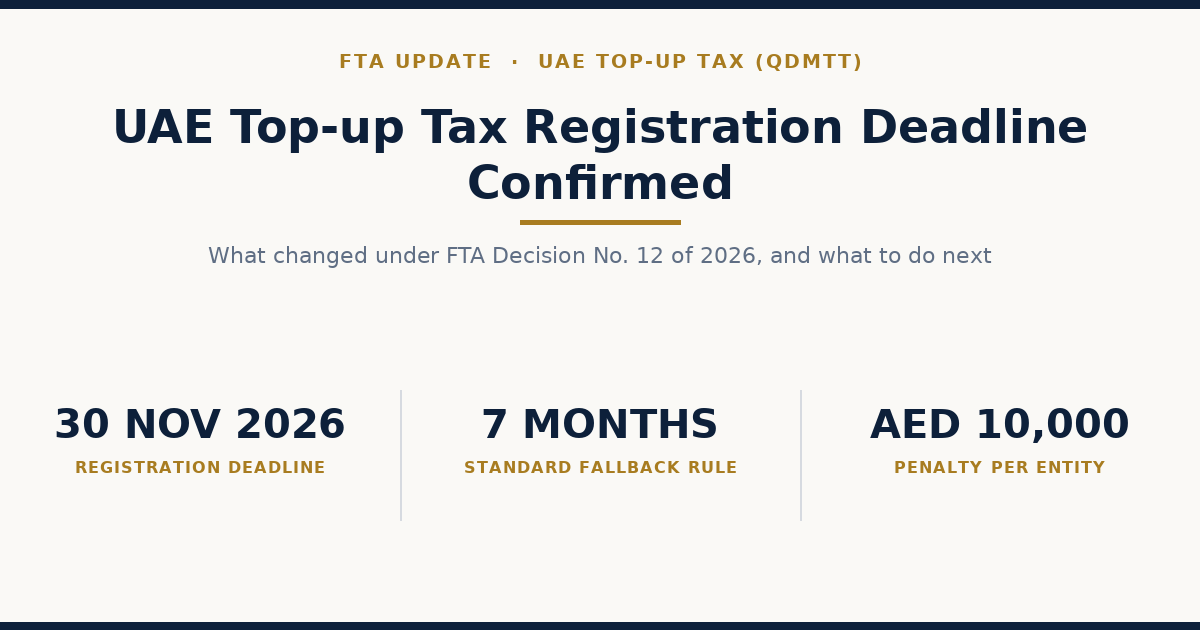
Quick update: The UAE Top-up Tax registration deadline is 30 November 2026 for any entity whose first in-scope Fiscal Year ended before 30 April 2026. Every other entity must register within 7 months of the end of its first in-scope Fiscal Year. Missing the deadline triggers an AED 10,000 administrative penalty per entity, and the FTA can register a non-compliant entity itself and backdate it. These rules come from the FTA’s August 2026 Scope and Registration guide (TTGREG1) and FTA Decision No. 12 of 2026.
For most of 2026, UAE groups have known one thing for certain: Top-up Tax registration is live on EmaraTax. What they haven’t had is a fixed date to work toward. That gap has now closed. In August 2026, the Federal Tax Authority published its Scope and Registration guide for Top-up Tax (TTGREG1), and for the first time set out, in one place, exactly when in-scope groups must register, what happens if they don’t, and how the process works.
This article walks through what’s actually changed, what the deadline means in practice, and what your UAE entities need to do before it arrives.
What Has Changed After the New FTA Guide?
| Previous position | New update from the FTA guide |
|---|---|
| EmaraTax registration was available, but the registration deadline wasn’t clearly published. | The FTA now confirms a fixed Top-up Tax registration deadline. |
| Businesses knew in-scope MNE groups may need to register. | The guide confirms any entity subject to Top-up Tax, including a Domestic Designated Filing Entity (DDFE) if one is appointed, must register with the FTA. |
| The Corporate Tax registration position was unclear for many groups. | The FTA confirms Top-up Tax registration is separate, and required even if the entity is already registered for Corporate Tax. |
| Penalty risk was general and undefined. | The FTA confirms an AED 10,000 administrative penalty for late Top-up Tax registration. |
| The DDFE’s practical role wasn’t clear. | The guide sets out both the entity-by-entity and the DDFE registration approaches. |
| Document requirements weren’t fully clear. | The guide lists the exact supporting documents needed for registration. |
1. What Is UAE Top-up Tax Registration?
UAE Top-up Tax is the UAE’s Qualified Domestic Minimum Top-up Tax, or QDMTT, the UAE’s version of the OECD’s global minimum tax under Pillar Two. It sits within the Corporate Tax framework, introduced by Federal Decree-Law No. 60 of 2023 and set out in detail in Cabinet Decision No. 142 of 2024 (the “QDMTT Legislation”), applying to Fiscal Years beginning on or after 1 January 2025.
It applies to UAE Constituent Entities of in-scope MNE groups. An MNE group is in scope if its consolidated revenue is EUR 750 million or more in at least two of the four Fiscal Years immediately before the tested Fiscal Year, as reported in the Ultimate Parent Entity’s consolidated financial statements.
That threshold is deliberately high. This is not a rule that touches a standalone UAE SME or a typical local group. It’s built for large, internationally structured multinational enterprises. If your group doesn’t clear the EUR 750 million consolidated revenue threshold in two of the last four years, then the rule does not apply to your business.
2. Confirmed Registration Deadline
This is the headline change. The FTA has set one rule with two branches, not two separate deadlines.
| Situation | Registration deadline |
|---|---|
| Fiscal Year ending before 30 April 2026 | On or before 30 November 2026 |
| All other cases | Within 7 months from the end of the first Fiscal Year in which the entity is in scope of QDMTT |
The 30 November 2026 date isn’t just “7 months, rounded.” It’s a transitional concession. A strict 7-month count from a 31 December 2025 year-end would land on 31 July 2026. But because the guide itself only arrived in August 2026, the FTA extended that group’s deadline to 30 November 2026 instead, giving affected businesses roughly four extra months. Groups with a Fiscal Year ending after 30 April 2026 don’t get that extension. They simply follow the standard 7-month count from their own year-end.
What this means in practice:
- Groups can no longer wait for “further guidance” on when to register. The date is now fixed and published.
- CFOs and tax teams need to map every UAE entity in the group now, and assign who is responsible for registering each one.
- If your group’s Fiscal Year ended on 31 December 2025, you fall under the first situation: your deadline is 30 November 2026, not the July date a straight 7-month calculation would suggest.
3. AED 10,000 Penalty for Late Top-up Tax Registration
An AED 10,000 administrative penalty applies to any entity that fails to submit its registration application within its deadline. Where a DDFE is representing multiple entities and misses the deadline for several of them, the AED 10,000 penalty applies separately, for each entity it failed to register, not once for the group.
There’s a sharper consequence behind the fine, too. If neither the entity nor its DDFE registers on time, the FTA can register the entity itself, based on whatever information it already holds, and that registration is backdated to the date the entity was originally required to register. In other words, missing the deadline doesn’t just risk a fine; it puts you on the FTA’s record as non-compliant from a date in the past, with the penalty still attached.
One distinction worth making clearly: transitional relief is not registration relief. The UAE has adopted the OECD’s Commentary and Agreed Administrative Guidance, which includes a globally recognised transitional penalty relief regime aimed at genuine, reasonable-cause errors in Top-up Tax calculations and returns during the early years. That relief has nothing to do with the registration deadline. Whether or not transitional relief applies to your group’s tax position, the AED 10,000 late-registration penalty and the 30 November 2026 / 7-month deadline still apply in full.
4. Corporate Tax Registration Does Not Replace Top-up Tax Registration
Top-up Tax sits inside the UAE’s Corporate Tax legislative framework, but the QDMTT Legislation has its own, separate registration requirement. The FTA guide is explicit: entities subject to Top-up Tax must register for it even if they’re already registered for Corporate Tax.
Entities already registered with the FTA for another tax reuse the same “Taxable Person” and Tax Identification Number on EmaraTax, but they still need a distinct Pillar Two Top-up Tax Registration Number. Being registered for Corporate Tax does not automatically cover Top-up Tax, and there’s no assumption in the legislation that it should.
This also applies to UAE Corporate Tax Groups. The FTA’s own worked example in the guide shows three UAE companies that form a single Corporate Tax Group still needing to register separately for Top-up Tax, either individually, or through one appointed DDFE. In other words, a Corporate Tax TRN is not related to your Top-up Tax registration status.
Practical impact: large groups cannot assume their existing Corporate Tax registration covers this. Every Constituent Entity’s Top-up Tax position needs to be checked on its own.
5. Who Must Register?
Any UAE entity that falls within the Top-up Tax charging provision must register, including:
- UAE Constituent Entities of an in-scope MNE group
- UAE Permanent Establishments treated as Constituent Entities (with two exceptions: a PE whose main entity is an Excluded Entity, and a stateless PE; neither of these registers)
- Minority-Owned Constituent Entities
- UAE Joint Ventures and JV Subsidiaries subject to Top-up Tax
- A Domestic Designated Filing Entity (DDFE), where one has been appointed
6. Entity-by-Entity vs DDFE Registration
Groups have two ways to register:
Entity-by-entity: each UAE Constituent Entity submits its own registration application and receives its own Pillar Two Top-up Tax Registration Number.
DDFE approach: a single Domestic Designated Filing Entity, which must itself be a member of the relevant Domestic Group, registers on behalf of all the entities it represents. The DDFE also takes on responsibility for filing the Top-up Tax Return and paying the Top-up Tax for the entities it represents.
One detail that’s easy to miss: a Domestic Main Group and a Domestic JV Group need separate DDFEs. If a group wants the DDFE approach for both its main UAE entities and a UAE Joint Venture structure, it must appoint two different DDFEs, one for each group, not one DDFE covering everything.
7. Registration Is Still Required Even If Top-up Tax Is Deemed Zero
This is one of the easiest points to get wrong. An entity’s computed Top-up Tax liability can be deemed zero under any of the following:
- the de-minimis exclusion
- the Transitional Country-by-Country Reporting (CbCR) Safe Harbour
- the Simplified Calculations Safe Harbour
- the initial phase of international activities exclusion
None of these remove the entity from the scope of the charging provision. It’s still “subject to Top-up Tax” in the FTA’s terms, which means it’s still required to register, even though no tax is currently due.
No tax payable does not automatically mean no registration.
8. Who Is Not Required to Register?
A small number of entity types sit outside the QDMTT charging provision entirely, and therefore don’t register at all:
- Excluded Entities, unless an election has been made not to treat the entity as excluded, in which case it does become subject to Top-up Tax and must register
- Investment Entities located in the UAE
- Stateless Permanent Establishments
- Stateless Tax Transparent Entities
This is a large enough topic that it deserves its own treatment. We cover exactly how Excluded Entities differ from Corporate Tax Exempt Persons, and what that means for MNE groups, in our companion guide: Excluded Entity vs Exempt Person: UAE Top-up Tax Rules Explained for MNE Groups.
9. Documents Required for Registration
The FTA guide lists the supporting documents needed to register for Top-up Tax:
- Document(s) verifying the name and Tax Identification Number of the Ultimate Parent Entity, where the UPE is located outside the UAE
- Document(s) verifying the name and Tax Identification Number of the Designated Filing Entity, if applicable and located outside the UAE
- Document(s) providing an overview of the MNE group’s corporate structure
- The FTA reserves the right to request any additional documents it considers necessary
If a DDFE is being appointed, each entity it represents must also authorise that appointment, either by acknowledging the DDFE directly on EmaraTax, or through a signed authorisation letter uploaded with the application.
10. What This Means for MNE Compliance in the UAE
Put together, the guide changes Top-up Tax from an open-ended obligation into a scheduled compliance task with a hard deadline. In practice, that means:
- Registration now runs on a fixed timeline, not an indefinite “when convenient” basis.
- Late registration carries a fixed, quantified penalty of AED 10,000 per entity.
- Top-up Tax registration has to be tracked separately from Corporate Tax registration, on its own record.
- Mapping every UAE entity against the QDMTT rules is now an urgent task, not a “later this year” one.
- Groups need to decide, entity by entity, whether to register individually or appoint a DDFE, and decide who that DDFE should be.
- Responsibility for the Pillar Two Information Return should be assigned at the same time as registration, not left for later.
- Supporting documentation and group structure records need to be ready before the application goes in, not gathered after an FTA request.
Need Help Confirming Your Registration Position?
If your group is approaching the EUR 750 million consolidated revenue threshold, or you’re not yet sure which UAE entities need to register, or by when, it’s worth getting a clear answer before the deadline, not after.
Need help checking whether your UAE entity must register for Top-up Tax? Our UAE Corporate Tax team can assess your QDMTT scope, identify your UAE Constituent Entities, prepare your registration documents, and support your EmaraTax Top-up Tax registration before the deadline. Get in touch to start your assessment.
FAQs
What is the UAE Top-up Tax registration deadline?
What is the penalty for late Top-up Tax registration in the UAE?
Do I need to register for Top-up Tax if my Corporate Tax Group is already registered?
Do I still need to register if my Top-up Tax liability is zero?
Who is exempt from UAE Top-up Tax registration?
Where do I register for UAE Top-up Tax?

Corporate Tax UAE
United Arab Emirates
Tel: +971 4 2500251 | Email:[email protected]